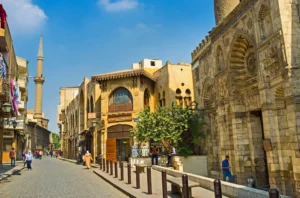
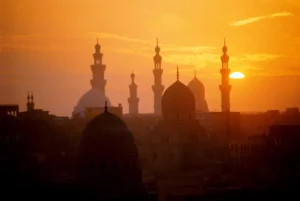
Al-Aqmar Mosque in Islamic Cairo, Egypt

Egypt: Cairo, Luxor, 5-night Nile River-Yacht cruise, Abu Simbel, Aswan
Aton river-yacht Privately Chartered, 16-passenger Ship
OR Aida or Amunet river-yacht Privately Chartered, 16-passenger Ship
OR Asiya river-yacht Privately Chartered, 16-passenger Ship
You depart today on your overnight flight from the U.S. to Cairo, Egypt.
Afternoon/Evening: Upon arrival in Cairo, an O.A.T. representative will meet you and escort you to your hotel.
After settling in, we’ll regroup in the lobby and your Trip Experience Leader will lead you and your fellow travelers, including those who just arrived from our Jordan: The King's Highway from Amman to Petra pre-trip extension and those who arrived early in Cairo before the main adventure, on an orientation walk around the hotel grounds and surrounding area.
Dinner: On your own. Your Trip Experience Leader can offer suggestions on where to dine, or you may choose to eat at the hotel’s restaurant.
Evening: After dinner, you’re free to explore on your own or retire to your room to rest up from your flight and prepare for tomorrow’s discoveries.
Breakfast: At the hotel.
Morning: We'll gather in the hotel with our Trip Experience Leader, who will set the stage for our discoveries in Egypt with a more formal Welcome Briefing. This briefing gives us the chance to introduce ourselves and get to know the other members of our small group. Perhaps you’ll also touch on the history of your accommodations. The Cairo Marriott Hotel is a former royal palace built by Khedive Ismail to accommodate Empress Eugénie of France (wife of Napoleon III) and other dignitaries traveling to Egypt to attend the opening of the Suez Canal in 1869. You can still see much of the original artwork and furnishings of the lavish palace in the hotel’s reception area and lounges.
Then, we’ll journey outside Cairo to the Giza Plateau to visit the Grand Egyptian Museum (GEM), home to the greatest Pharaonic treasures in the world. The world’s largest archaeological museum covering a single civilization, the museum’s vast exhibits will lend context to our later discoveries as we trace the history of Egypt from Cheops to Cleopatra. After our guided tour, we’ll enjoy lunch at the museum.
Lunch: At a restaurant inside the Grand Egyptian Museum.
Afternoon: After lunch, enjoy free time to further explore the Grand Egyptian Museum on your own before returning to our hotel in Cairo. You’ll have a little time to relax before our Welcome Dinner this evening.
Dinner: Tonight, we’ll enjoy a Welcome Dinner at a local restaurant.
Evening: You are free to retire to your room or perhaps purchase some cocktails at the bar with your fellow travelers and talk about the day's discoveries.
Breakfast: At the hotel.
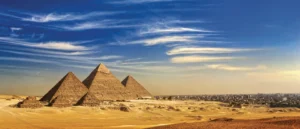
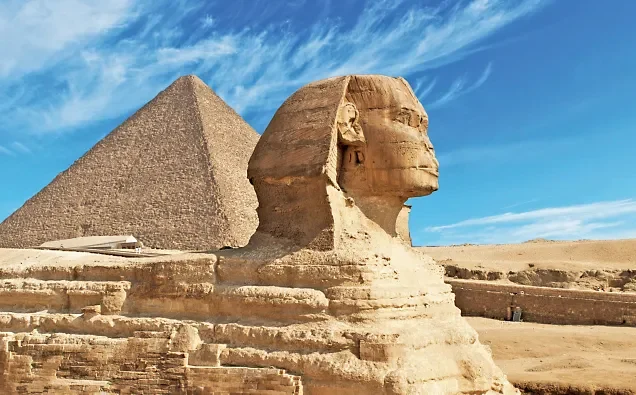
Morning: Drive to Giza to behold the Great Pyramids, including the greatest of them all—the 4,500-year-old Great Pyramid of Khufu. The only survivor of the Seven Wonders of the Ancient World, the Great Pyramid was built for the Egyptian Pharaoh Khufu (Cheops in Greek) and was the world’s tallest man-made structure for more than 4,000 years. We can ponder another mystery for the ages at the Sphinx, enigmatic guardian of the Giza Plateau.
Lunch: At a local restaurant.
Afternoon: Return to our hotel for the remainder of the afternoon free to relax or do some further exploring independently. Then, we’ll join a local woman to discuss the Controversial Topic of laws protecting women's rights in Egypt versus the reality of traditional women's roles. Egypt has made progress toward gender equality in recent years. But while many laws have been put in place to protect and strengthen women's rights at home and in the workplace, the reality is more complex. In many local communities, these laws are doing little to change longstanding traditional roles for women in Egyptian society. We will meet a local Egyptian woman who give us an overview of new laws the Egyptian government has put in place to enforce women's rights and how these laws are having little impact in many local communities. She'll share her personal story and tell us about the obstacles many women still face in communities that are resisting women's independence.
Dinner: On your own. Ask your Trip Experience Leader for suggestions.
Evening: The remainder of your evening is free for you to take advantage of the hotel’s amenities, relax with your travel companions in the lounge, or retire to your room and prepare for tomorrow’s flight to Luxor.
Activity Note: Today's activities require an early wakeup call.
Breakfast: A breakfast box will be available for travelers at the hotel early this morning.
Morning: Early this morning, we’ll head to the airport for our flight to Luxor—which will be like a journey back in time from Egypt’s current capital, Cairo, to its ancient capital of Thebes. While flying high above the Nile, one gains an appreciation of how the mighty river enabled such a magnificent civilization to develop along its fertile banks—something noted by the ancient Greek historian Herodotus, who called Egypt the “Gift of the Nile.”
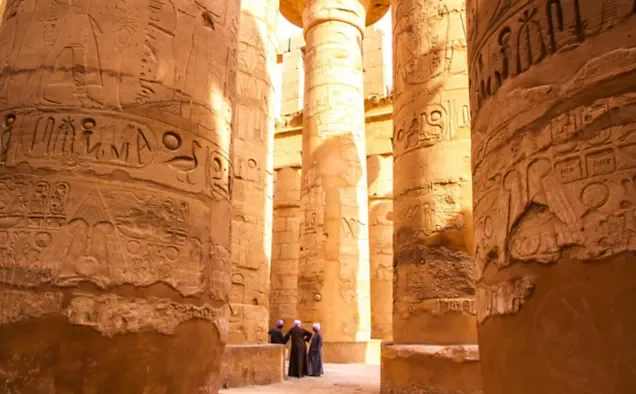
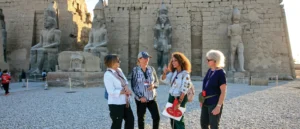
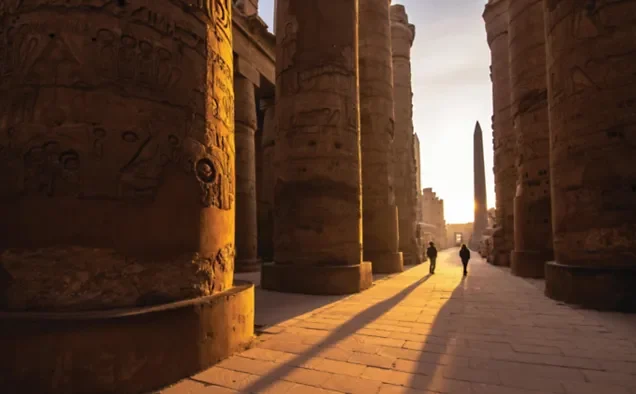
Modern-day Luxor grew out of the ruins of ancient Thebes. And we’ll begin to grasp the scope and grandeur of the monuments and temples along both banks of the Nile at this special locale—Luxor Temple and the Temple of Karnak on the East bank, and the remote Valley of the Kings on the West bank. Upon our arrival in Luxor this morning, we’ll explore the Temple of Karnak. With its massive gate, Karnak is one of the most important ancient sites in all of Egypt. Ancient Egyptians, who believed that their chief deity Amun-Ra first created himself and then everything else, called Karnak Ipet-Isut, “the most perfect of places.” And perfection was eventually attained at Karnak, which was built over the course of 1,300 years by successive kings and queens, who each added their own tributes to Amun-Ra, replacing or expanding existing monuments in ever more grand styles.
Lunch: At a local restaurant.
Afternoon: We’ll check in to our hotel, situated along the Nile River.
Once settled in, we'll regroup in the lobby of our hotel for one of the highlights of our Egypt adventure: a Home-Hosted Dinner with a local family. We'll break up into smaller groups and depart for the home or apartment of our host family, which will be located in the suburb of Awamiya. This is a unique opportunity to learn more about life in the region—so come hungry for your home-cooked meal, and bring plenty of questions for your welcoming hosts.
Dinner: Dine in the home of a local family, and learn about life in the legendary city of Luxor from these residents while we watch as they prepare an authentic dinner. Each family has a different background—some of them may be teachers, chefs, bank tellers, or shop owners, for example. Our meal this evening may consist of typical regional dishes—like mahshi (eggplant and zucchini), moussaka (an eggplant, meat, and potato-based dish), and tahini salad (made from toasted, ground sesame)—and the family will sit down with us to savor it. We'll finish off our meal with a traditional dessert such as basbousa, cake sweetened with a simple syrup, or knafah, filo pastry filled with cheese.
Evening: The rest of your evening is free to explore or relax at the hotel.
Activity Note: The visit to the Valley of the Kings includes walking over uneven terrain and, depending on which tombs we are allowed to visit, may require navigating up and down some difficult wooden steps inside of the tombs.
Breakfast: At the hotel.
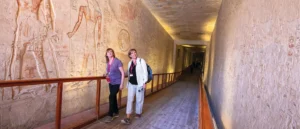
Morning: We’ll depart the hotel in the morning, crossing over to the west bank of the Nile by motorcoach to reach the Valley of the Kings. The Valley of the Kings, situated in a secluded locale in the Theban Hills, is where the great pharaohs were buried in rock-cut tombs and surrounded by all the treasures they would need in the afterlife. Almost all of the sacred burial chambers were plundered over the millennia—with the exception of an obscure young ruler whose reign lasted a mere decade. On the afternoon of November 26, 1922, British archaeologist Howard Carter made a small hole in a sealed doorway, inserted a candle, and peered inside. Completely untouched, Tutankhamen’s burial chambers contained thousands of priceless objects inside, along with a gold coffin containing the mummy of the teenage king.
Upon arrival in the Valley of the Kings, we’ll set off on a walking tour, which includes a visit to the tomb of this young pharaoh, followed by a visit to the Temple of Queen Hatshepsut, built for Egypt’s first known female monarch. Ruling for 20 years in the 15th century B.C., Hatshepsut is also considered one of Egypt's most successful pharaohs.
Lunch: At a local restaurant.
Afternoon: Return to our hotel, where you'll have the balance of the afternoon free.
Later, we'll explore Luxor Temple, a center of power for Egypt’s mighty pharaohs over a nearly 1,500-year period. The temple complex was largely built by Amenhotep III and Ramses II, the greatest and most celebrated pharaoh of the New Kingdom. Many other pharaohs and rulers added to the temple over the centuries. Tutankhamen even contributed some—the only mark left by the boy king who is far more famous for being dead than alive. After exploring the series of statues, halls, columns, and pillars of Luxor Temple, we can turn our gaze to the incredible avenue of sphinxes that begin here and stretch for more than a mile into the distance, all the way to Karnak.
Dinner: At a local restaurant.
Evening: Your final night in Luxor is free to explore on your own or begin packing for tomorrow’s journey to Esna.

Breakfast: At the hotel.
Morning: You may elect to rise early for an optional balloon ride over the west bank to witness a glorious Egyptian sunrise over the Nile. Then, we’ll drive south to Esna, a town on the Nile’s western bank. An important stop on the camel-caravan route for centuries, Esna is also home to the grand Temple of Khnum, which we’ll visit upon our arrival. Then, we’ll board our private river-yacht to begin our Nile River cruise.
Lunch: Aboard our yacht.
Afternoon: While we’re enjoying lunch, our private, classic Nile river-yacht will have already set sail as we begin one of the highlights of our Egypt adventure. To set your expectation for the days ahead, a word about our private 16-passenger dahabeya—your accommodations for the next five nights: This is not your typical large river ship, packed with travelers, chugging up and down the Nile (we’re content to let those big boats pass us by). Instead, you’ll experience a gentler, more gracious era in travel. In fact, the history of the dahabeya goes back to the Pharaonic times, and inscriptions of these vessels have been found in the tombs of ancient Egyptian Kings. They take their name from the Arabic word for gold (dahab), since the earliest form of this boat was golden colored. As we glide quietly across the Nile’s timeless waters, guided by the gentle winds and whims of the currents, our small motorized tender is there to nudge us along when we require assistance. The intimate size of our vessel also allows us to visit ancient temples at quiet times, and gives us access to the smaller islands and riverside villages that travelers on the big river ships can only dream about. And at night, we’ll be far away from the bright lights and lines of the noisy tourist steamers. Quietly moored in secluded locales, we can spend peaceful evenings relaxing on deck, gazing out at the Nile to imagine a time when Cleopatra and Julius Caesar drifted past these very same waters aboard the Egyptian queen’s gilded barge.
With a crew of 15 along to provide attentive, personal service to our small group of just 16 travelers, you may feel a bit like a queen or a pharaoh yourself as we begin our romantic journey along the Nile this afternoon. Our first cruise will last approximately four hours, plenty of time to appreciate just how relaxing this form of Nile travel can be while taking in the vistas to either side of the river where life plays out along its banks unchanged for centuries. We'll arrive in Higz, a small village along the Nile’s east bank, and take a village walk before watching the sun set over the Nile before returning to our yacht.
Dinner: Aboard our yacht.
Evening: You are free to relax on deck to admire the night sky or settle into your cabin for the night.
Breakfast: Aboard our yacht.
Morning: After breakfast, we set our course for Edfu. During our scenic 5-hour cruise, perhaps you'll join our Trip Experience Leader for a discussion on pharaonic life, or maybe try your hand at senet, an ancient Egyptian board game that was a favorite pastime of Tutankhamen.
Lunch: Aboard our yacht.
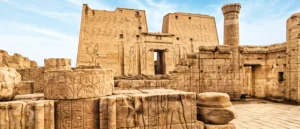
Afternoon: Arrive at Edfu, a town on the west bank of the Nile that is home to the best-preserved cult temple in Egypt. Here, we’ll visitthe Temple of Horus, dedicated to the falcon-headed god. After exploring the remarkable hieroglyphs and bas-reliefs of Egypt’s second largest temple, we’ll cruise well beyond the lights and noise of Edfu to moor for the night at Fauaza, a quiet little village further down the Nile.
Dinner: Aboard our yacht.
Evening: Free to mingle with your fellow travelers over a drink at the bar, or retire to your cabin for the night.

Breakfast: Aboard our yacht.
Morning: When we rise this morning, our yacht will have already set sail. So, during our breakfast, we can admire the palm trees, farmland, donkeys, and tranquil scenes of traditional Egyptian life as we slowly cruise farther south along the Nile. We’ll then arrive at Besaw Island to begin our NEW A Day in the Life discoveries with a local farmer and his family. The ancestors of these local farmers moved to this island after the building of the Aswan High Dam. As irrigation became more regulated and agrarian reform took effect, Besaw transformed into a viable, agricultural haven, and land previously owned by the wealthy was redistributed among agricultural workers. This 500-strong island community primarily cultivates mangoes, bananas, dates and feed for their livestock. They are noticeably isolated from surrounding areas, as there are no bridges, no modern developments, and electricity only came to the island around 2010. Besaw is seemingly frozen in time, where the pace of life is much like the gentle breeze and long-established traditions are the beating heart of local culture.
Upon arrival at the farmer's property, we’ll be welcomed into their home. There, we’ll begin with a conversation about education for girls living on the island. As we learned earlier on our journey, Egypt is quite split on the subject of women’s rights and the resistance to such progress is significantly greater in rural areas like Besaw. Many residents believe that learning to read and write is sufficient education for girls and that they should begin thinking about marriage in their teenage years. Furthermore, education can be a burden on families because children must travel to the mainland to attend school—meaning parents and elders lose out on the extra domestic help. However, as we get to know our host, we’ll come to find out that not all people here have such old-world views on the subject. We’ll also have the opportunity to ask any questions we might have about the issue—perhaps you’d like to know how forward-thinking residents are working to change the minds of conservative neighbors, or you might wish to ask about local school curriculums.
Then, we’ll stretch our legs with a walk through the village crop fields. In summertime, we’ll stroll through dense rows of lush mango plants and banana palm trees—two of the most lucrative commodities grown here—and if we happen to visit in winter, we’ll see zucchini, tomatoes, lettuce, okra, parsley, and other types of produce. We’ll also have the chance to observe some of the livestock, such as water buffaloes, cows, sheep, and various poultry. All of this life is sustained, of course, by strategic irrigation methods, which we’ll learn about and even have a chance to try our hand at throughout our walk. Depending on the time of year, we may also have the opportunity to seed the land or harvest some of the crops.
Lunch: In the farmer's home, featuring traditional dishes like orzo chicken soup, sun-baked bread, fried chicken, or beef stew, followed by a semolina-based dessert.
Afternoon: We'll head back to our river-yacht and resume sailing. Then, we’ll reach the narrowest stretch of the Nile, an area the ancient Egyptians called Khenu, or "the place of rowing." Our destination is Gebel Si lsila, a rocky gorge where high sandstone cliffs descend down to the water’s edge. Our small river-yacht will drift alongside the ancient quarries that provided the stones to build almost all of Egypt’s great monuments and temples, including Karnak, Luxor, Kom Ombo, and many others. You can be among the few to explore this historic site, and learn about a recent archaeological discovery made here—a massive sacred temple used for four epochs of ancient Egyptian history. Our Trip Experience Leader will shed light on this historical finding, during which we can ask any questions we might have.
Dinner: We’ll venture ashore for a traditional Egyptian dinner on Gebel Silsila (weather permitting).
Evening: We’ll then head back to our river-yacht and enjoy the remainder of the night free for our own discoveries.
Breakfast: Aboard our yacht.
Morning: Venture off the yacht to explore Fares Island, visiting the traditional Egyptian village before a stop to see a local craftsman. Then, we’ll go back onboard our yacht to begin our cruise to Kom Ombo.
Lunch: Aboard our yacht.
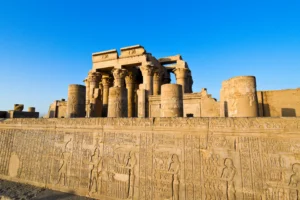
Afternoon: Arrive at Kom Ombo, a riverside town surrounded by sugar cane fields that is home to Egypt’s only double temple. Dramatically situated along a bend on the Nile, the beautiful Graeco-Roman Kom Ombo Temple features one side dedicated to the local crocodile god, Sobek, and the other side dedicated the falcon god, Haroeris. A unique feature of Kom Ombo is a series of engravings thought to be among the world’s first representations of medical and surgical instruments. After exploring Kom Ombo, we’ll return to our river-yacht and cruise to the nearby town of Daraw.
Dinner: Aboard our yacht.
Evening: Free to relax with your travel companions on the yacht while we moor for the night in Daraw.
Breakfast: Aboard our yacht.
Morning: Discover what really draws the locals to Daraw—the livestock market. Throughout the year, cows, goats, camels, and other livestock are traded in a bustling weekly market here. Because we are traveling in such a small group, we’ll hop aboard pick-up trucks, a more modern form of local transport, and head over to the market or the livestock barns. With herders urging their camels and goats along, and men hawking their produce as they squeeze through the crowds in their tuk-tuks, the scene can be dusty, colorful, chaotic—and fun. Then, we’ll set off on a cruise to Aswan, our final port-of-call.
Lunch: Aboard our yacht.
Afternoon: You’ll want to be on deck as we drift along this enchanting stretch of the Nile where the desert closes in on the river, tropical islands abound, and lateen-sailed feluccas are seen gliding past the ancient ruins.
Dinner: Aboard our yacht.
Evening: We’ll arrive in Aswan and moor for the night at the city’s edge, relatively secluded from Aswan’s main bustle. You can relax on deck this evening and take in the views of the Nile and Aswan for the final night of our cruise.
Breakfast: Aboard our yacht.
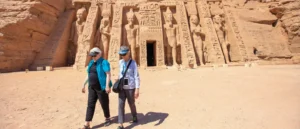
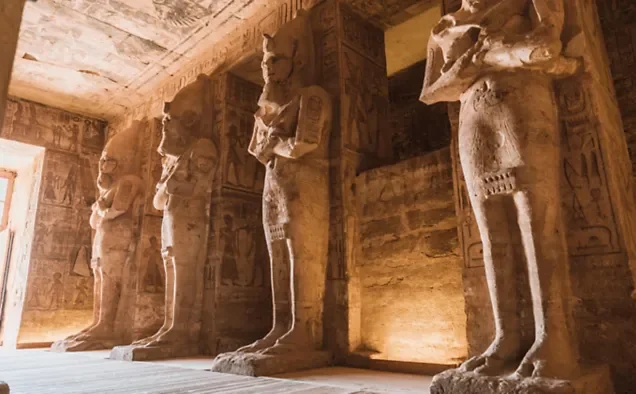
Morning: Bid farewell to our captain and crew and travel overland to Abu Simbel for an overnight stay. Upon arrival, we’ll explore the ancient relics and structures for which the area is known. We’ll see this ancient wonder fully intact, with its huge guardian statues and elaborate depictions of famous battles on the inner walls of Ramses’ Temple. It has been said that this famed king was something of a narcissist—we’ll see ample evidence of that here in the sheer number of objects depicting him, including a mammoth statue in which his head appears to support the weight of the entire temple. The massive colossi of Ramses II were an expression of Egypt’s might and its dominance over the Nubian kingdom.
When Lake Nasser was created as a result of the construction of the Aswan High Dam, some 100,000 Nubians were displaced. Not only did the High Dam’s construction upend the lives of Nubians, but it appeared that the massive temples of Abu Simbel—hewn out of the solid cliff in the 13th century B.C.—were doomed to vanish beneath the rising waters of Lake Nasser. But the entire complex was cut into 1,036 blocks (weighing eleven tons each), and thanks to the labor of 25,000 workers over three years, was moved 200 feet up the cliffs and safely re-established above the new water level.
After exploring the area, we'll check in to our centrally located hotel.
Lunch: At our hotel.
Afternoon: Following lunch, you’ll have free time to relax or venture out on your own. Perhaps after the drive this morning you’d prefer to settle into the hotel and enjoy some tea—or you may wish to consult with your Trip Experience Leader for ideas. Then, we’ll continue our discoveries with a short drive back to Abu Simbel, where we’ll gain an entirely new perspective of the site during an enchanting sound and light show. The illuminated temples and relics provide a dramatic lens through to which to experience the rich history and heritage before us.
Dinner: At our hotel.
Evening: Free to relax and enjoy the amenities of our hotel or return to our rooms to beginning packing for tomorrow’s transfer back to Aswan.
Breakfast: At our hotel.
Morning: Depart Abu Simbel and drive back to Aswan for our two-night stay. Set along an enchanting stretch of the Nile, Aswan is an ancient frontier town where life glides by as gently as the canvas-sailed feluccas that drift past the tropical islands dotting the river’s sapphire waters. Along the way, we’ll make a stop at the Aswan High Dam, whose 1971 construction created the massive Lake Nasser.
Lunch: At a local restaurant.
Afternoon: We'll arrive in Aswan, and check into our hotel.
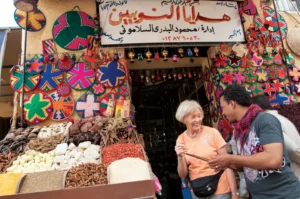
During some free time this afternoon, you may want to explore the hotel. Or you can shop for keepsakes such as papyrus art or perhaps a 14-carat gold cartouche with your name in hieroglyphics. After, we’ll gather together for a discovery walk through Aswan’s bustling spice market. We’ll hunt for bargains at a colorful bazaar of aromatic spices, Nubian crafts, embroidered galabayas (traditional Egyptian garments), and more, before heading over to a local restaurant for dinner.
Dinner: At a local restaurant.
Evening: Free to relax, enjoy a drink at the hotel, or perhaps just soak in the history of this legendary city.
Breakfast: At the hotel.
Morning: Depart our hotel by bus, and then take a boat to the island temple of Philae, center of the cult of the goddess Isis. Similar to the plight of Abu Simbel, this temple complex was moved in order to save it from the rising waters of Lake Nasser. Our discoveries include the Temple of Isis, with its courtyards flanked by granite lions and walls covered in ancient gods and goddesses; and Trajan’s Kiosk, with its 14 majestic stone pillars.
Lunch: At a local restaurant.
Afternoon: We’ll return to our hotel for a few hours of free time to relax or to explore on your own.
Dinner: Enjoy a festive Farewell Dinner tonight. This is a great time to celebrate our Egypt discoveries with the entire group while dining on the traditional Egyptian fare that we’ve come to know during our adventure.
Evening: Free to enjoy time at the hotel, witness life along the Nile, or to begin packing for tomorrow’s flight to Cairo.
Breakfast: At the hotel.
Morning: Transfer to the airport for our flight north to Cairo.
Lunch: Enjoy a boxed lunch on our bus while we drive into the city to explore two of Cairo's most famous mosques.
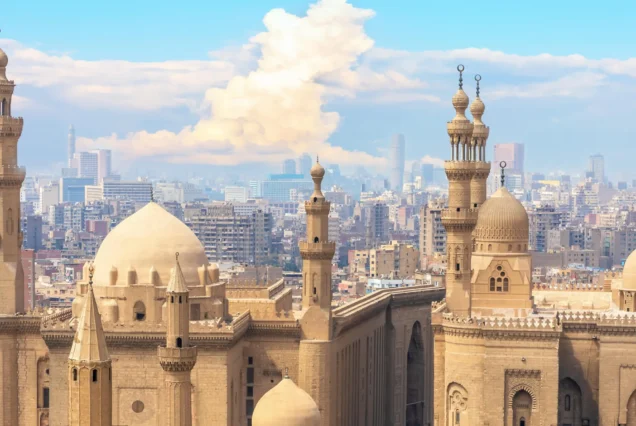
Afternoon: Visit the Mosque-Madrassa of Sultan Hassan and its historic counterpart, the Al Rifa'i Mosque. Standing side by side, the Mosque-Madrassa of Sultan Hassan was constructed during the mid-14th century and is one of the largest mosques in the world. The massive Al Rifa'i Mosque, completed in 1912, was built to showcase the modernization of Egypt's capital while embracing the glory years of its Islamic history and features many Mamluk architectural influences. As the burial place of a number of Egyptian royal family members, the Al Rifa'i Mosque is also known as the Royal Mosque.
After, we’ll check in to our Cairo hotel, and then have some free time for our last day in Egypt—perhaps to witness the panoramic views of the city from atop Cairo Tower or to do some last-minute shopping before returning home.
Dinner: At the hotel.
Evening: Free to relax at the hotel to compare Egypt memories with your fellow travelers or begin packing for tomorrow’s return flights home.
Breakfast: At the hotel.
Morning: Transfer to the Cairo airport for your return flight back to the U.S., or begin your post-trip extension to Alexandria's Glorious Past.




Reviews
There are no reviews yet.